Finance
Tax and Finance Guide for Self-Employed Barristers in the UK

For a barrister, the courtroom is a place of precision, logic, and meticulous detail. Yet, many of the UK’s most brilliant legal minds find that the same level of mastery does not always translate to their own balance sheets. Being a self-employed barrister is, in essence, running a high-stakes boutique consultancy where you are the sole product, the service provider, and the administrative lead.
The financial life of the Bar is unlike almost any other profession. You face the “feast or famine” reality of irregular income, the frustration of delayed case payments from solicitors, and a VAT regime that can feel like a labyrinth. While your focus remains on winning the next case, the underlying pressure of tax compliance and cash-flow management can become a silent burden.
Whether you are a junior tenant just starting your practice or a seasoned Silk looking to optimize a substantial portfolio, understanding the financial architecture of your career is essential. This guide explores the core pillars of financial success for barristers, from managing “Payments on Account” to identifying the niche deductions that generalist accountants often miss.

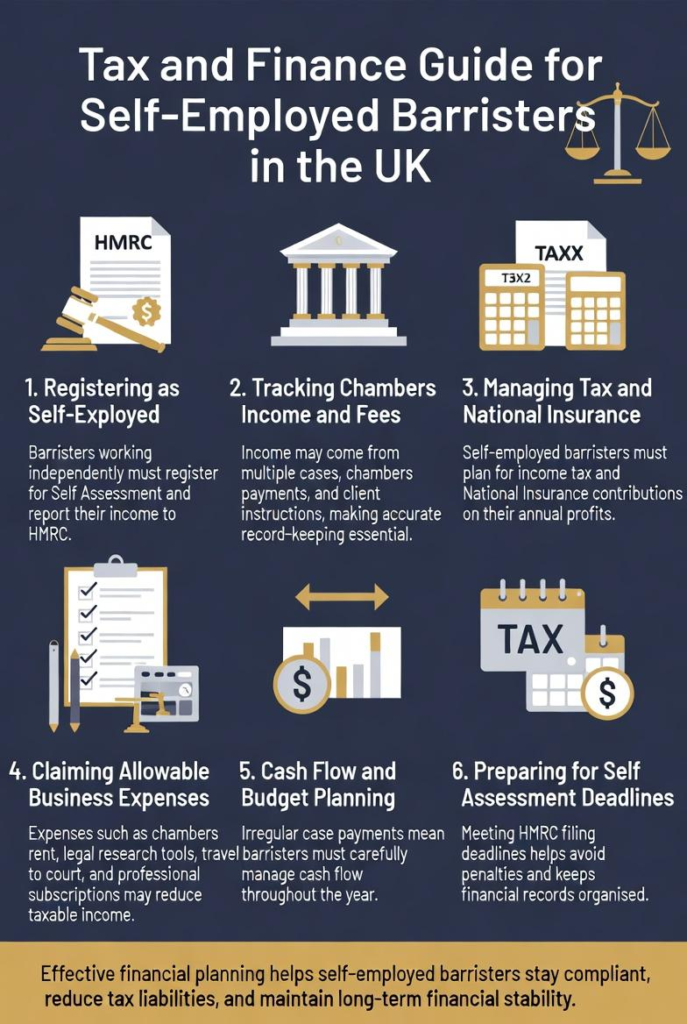
1. Understanding the Financial Structure of Barristers
How Barristers Work Financially
The vast majority of barristers in England and Wales are self-employed sole traders. Unlike many of your peers in the legal sector where accountants for solicitors often deal with partnership structures or limited companies, barristers generally cannot incorporate their practice. You operate as an independent contractor, usually within a “Chambers” structure.
The Relationship with Chambers
Chambers are not your employer; they are a service provider. You pay “chambers rent” or a percentage of your earnings to cover the cost of the building, administrative staff, and, most importantly, the clerks.
The Clerks and Billing
Your clerks are your primary business managers. They negotiate your “Brief fees” (the fixed fee for a case) and your “Refreshers” (daily court fees). However, while clerks are experts at billing, they are not tax advisors. They focus on billing income, but the responsibility for managing that income, setting aside tax, handling VAT, and preparing for retirement rests entirely on your shoulders.
Why Barristers’ Finances are Unique
The “delayed payment” culture in the legal industry is perhaps the greatest challenge. It is not uncommon for a barrister to perform work in January and not receive payment until July or even the following year. This disconnect between effort and reward makes traditional budgeting nearly impossible without expert intervention.
2. How Self-Employed Barristers are Taxed in the UK
As a self-employed professional, you fall under the HMRC Self-Assessment regime. Your tax is not deducted at source; instead, you pay tax on the profits your practice makes after allowable expenses are deducted.
Income Tax and National Insurance
You are subject to the standard UK progressive tax bands:
- Basic Rate (20%)
- Higher Rate (40%)
- Additional Rate (45%)
In addition to Income Tax, you must pay National Insurance Contributions (NICs). Following recent legislative changes, Class 2 NICs have been effectively abolished for most, but Class 4 NICs remain a percentage of your profits that must be factored into your annual liabilities.
The Self-Assessment Cycle
The tax year runs from 6 April to 5 April. The deadline for filing your digital return and paying your remaining tax for the previous year is 31 January. Missing this deadline results in immediate penalties, but for barristers, the real danger isn’t just the penalty .It is the “shock” of the bill itself.
3. Payments on Account: The “Double Bill” Surprise
If there is one area where junior barristers get caught out, it is Payments on Account. If your tax bill is more than £1,000, HMRC assumes you will earn at least the same amount next year. They require you to pay half of your next year’s estimated tax in advance.
The Scenario
Imagine it is your first full year of practice. You owe £20,000 in tax. On 31 January, you must pay:
- The £20,000 for the year you just finished.
- An additional £10,000 as the first “Payment on Account” for the upcoming year.
Suddenly, a £20,000 liability becomes a £30,000 cash requirement. Without a dedicated tax reserve, this can cause a significant cash-flow crisis. Expert financial planning involves calculating these “look-ahead” liabilities months in advance so there are no surprises when January arrives.
4. VAT Rules for Barristers: Timing is Everything
VAT is perhaps the most complex area of accounting for the Bar. Once your taxable turnover exceeds the current threshold (£90,000 as of 2024), you must register for VAT.
The “Tax Point” Confusion
For most businesses, the tax point is the date the invoice is issued. For barristers, however, there are special rules. Because of the delay in payments, many barristers use the Cash Basis for VAT, meaning they only account for VAT when the payment is actually received into their bank account.
However, if you issue a VAT invoice, that can trigger a tax point. Navigating the intersection of “Fee Notes” (which are not VAT invoices) and “VAT Invoices” (issued upon payment) is where many barristers make errors that lead to HMRC inquiries.
5. Managing Irregular Income: The 30% Rule
Because you might receive £30,000 one month and £2,000 the next, you cannot live on your “bank balance.”
The Strategy
We advise barristers to adopt a strict “Tax Reserve” policy. Every time a solicitor pays a fee note, immediately transfer 25% to 30% into a separate, high-interest savings account. This money does not belong to you; it belongs to HMRC.
By treating your gross income as “business revenue” and only your net-of-tax income as “personal salary,” you build an automatic buffer. This buffer becomes your lifeline during slow periods, such as the summer recess or during a long-running case where the brief fee hasn’t yet been triggered.
6. Allowable Tax Deductions: What Can You Actually Claim?
One of the primary benefits of being self-employed is the ability to deduct “wholly and exclusively” business expenses from your income, reducing your taxable profit.
Chambers Expenses
- Chambers Rent/Flat Rate: This is usually your largest deduction.
- Clerk Commissions: The percentage paid to your clerks for securing and managing work.
Professional Costs
- Bar Subscriptions & Practising Certificates: The mandatory costs of being at the Bar.
- Inns of Court Fees: Annual memberships and event costs.
- CPD and Training: The cost of keeping your legal knowledge up to date.
- Legal Research Tools: Subscriptions to LexisNexis, Westlaw, or specialized law reports.
Travel and Subsistence
Travel to court or to a client’s place of business is deductible. However, your daily commute to your “base” (your Chambers) is generally not deductible. If you are required to stay overnight for a case, your hotel and reasonable meal costs are allowable.
The “Wig and Gowns” Rule
HMRC allows deductions for specialized professional attire that cannot be worn as everyday clothing. This includes your wig, gown, and bands. However, standard “court suits” or shirts are generally not deductible because they provide “basic human cover” and could technically be worn outside of work even if you only ever wear them in the Robing Room.
7. Making Tax Digital (MTD): The Future of the Bar
HMRC is moving toward a fully digital tax system. Under Making Tax Digital for Income Tax Self-Assessment (MTD for ITSA), barristers with qualifying income will soon be required to:
- Keep digital records of all transactions.
- Send quarterly updates to HMRC instead of one annual return.
- Use MTD-compatible software.
For a busy barrister, the requirement to file data every three months is a significant administrative hurdle. Preparing now by transitioning from spreadsheets to cloud-based accounting software like Xero or QuickBooks is essential.
8. Financial Planning: Smoothing the Peaks and Troughs
Beyond mere tax compliance, true financial success for a barrister involves long-term wealth planning.
Pension Contributions
Contributing to a pension is one of the most tax-efficient moves a barrister can make. Contributions attract tax relief at your highest marginal rate. If you are a 45% taxpayer, a £10,000 pension contribution effectively only “costs” you £5,500, while the full £10,000 grows in a tax-sheltered environment.
Income Smoothing
Since you cannot use a Limited Company to “retain” profits, you must use other vehicles to smooth your income. This includes maximizing your ISA allowances and maintaining an emergency fund equivalent to 6 months of Chambers rent and personal expenses.
9. Why Barristers Need a Specialist Accountant
The legal world is specialized, and your accounting should be too. While many firms act as accountants for solicitors, the requirements for the Bar are distinct. A generalist accountant may not understand the specific VAT “tax point” rules for barristers or how to properly treat Chambers’ recharges.
The Mortgage Challenge
Barristers often face difficulties when applying for mortgages. Lenders see the irregular income and become hesitant. A specialist accountant understands how to present your “aged debt” and your consistent track record to lenders, proving your creditworthiness despite the fluctuating monthly deposits.
10. How Lanop Business and Tax Advisors Help the Legal Profession
At Lanop, we have built our reputation as premier accountants for solicitors and barristers alike. We understand that your time is your most valuable asset. Every hour you spend wrestling with a VAT return is an hour you aren’t billing or preparing for a trial.
Our Specialist Services for Barristers
- Bespoke Tax Planning: We look at your specific call level and practice area to optimize your tax position.
- VAT Management: We handle the complexity of the barrister VAT rules, ensuring you only pay what is owed when the cash arrives.
- Cloud Accounting Integration: We move your practice onto digital platforms, making you fully MTD-ready.
- Cash Flow Forecasting: We help you visualize your upcoming “Payments on Account” so you can invest your surplus cash with confidence.
We provide more than just a year-end service; we are your year-round financial clerks, ensuring your practice is as robust as your legal arguments.
Frequently Asked Questions
1. How does the self-employed tax system work for barristers?
As a self-employed barrister, you pay income tax on your profits (fees minus expenses) and Class 2 and Class 4 National Insurance through Self-Assessment. Tax isn’t deducted at source; you calculate what you owe and pay HMRC directly by January 31st, with a second payment on account due July 31st.
2. What expenses can barristers claim to reduce their tax bill?
You can claim chambers rent and service charges, clerks’ fees, professional subscriptions (Bar Council, Inn of Court), legal books and research subscriptions, professional indemnity insurance, wigs and gowns, travel to court, CPD courses, IT equipment, and accounting fees. Keep all receipts and only claim genuine business expenses.
3. Should I operate through a limited company or stay self-employed?
Most barristers stay self-employed because the Bar Standards Board regulates practice structures, and chambers arrangements work best this way. Limited companies can be tax-efficient at higher incomes but add complexity and may conflict with chambers’ fee-sharing. Always consult a specialist barrister accountant before considering incorporation.
4. How do I handle irregular income and manage cash flow as a barrister?
Set aside 30%–40% of every payment for tax and National Insurance in a separate account. Build an emergency fund covering 3–6 months of expenses to manage gaps between payments. Use accounting software to track outstanding fees and chase late payments systematically to maintain cash flow.
5. What are payments on account and how do they affect my tax planning?
Payments on account are advance payments toward next year’s tax, calculated as 50% of your previous year’s liability, paid in January and July. If you had a high-earning year, next year’s payments can be substantial even if income drops. Save consistently and consider applying to reduce payments if your income genuinely falls.
Final Thoughts: Securing Your Financial Future
Success at the Bar is measured by more than just the “win.” It is measured by the sustainability of your practice and the security of your future. By mastering the fundamentals of cash flow, staying ahead of digital tax changes, and claiming every legitimate deduction, you ensure that your hard work in court translates into lasting personal wealth.
Financial management shouldn’t be a source of stress. With the right systems and specialist support from Lanop Business and Tax Advisors, it can become a streamlined part of your professional life.
Ready to optimize your practice’s finances? Contact Lanop Business and Tax Advisors today for a consultation with our specialist legal accounting team. Whether you are at the start of your career or preparing for the bench, Lanop Business and Tax Advisors is here to ensure your finances are always in order.
Read more on WCCO