
News
How Distracted Driving Is Putting Los Angeles Cyclists at Risk


Every day, cyclists share busy Los Angeles streets with motorists, buses, ride-hail vehicles, and delivery drivers. While bicycles are a healthy and eco-friendly way to get around, riders are extremely vulnerable when a distracted driver makes a mistake. An experienced Los Angeles bicycle accident lawyer sees firsthand how simple distractions behind the wheel can lead to catastrophic injuries for cyclists — and why awareness and legal strategy matter when crashes happen.
Distracted driving is one of the leading causes of preventable collisions in Los Angeles, and cyclists pay the price when drivers fail to keep their full attention on the road.
What Is Distracted Driving?
Distracted driving refers to any activity that draws a driver’s attention away from safely operating a vehicle. Distractions can be visual (eyes off the road), manual (hands off the wheel), or cognitive (mind not on driving). Common examples include:
- Texting or reading messages
- Talking on a phone
- Adjusting navigation systems
- Interacting with passengers
- Eating or drinking
- Reaching for objects inside the car
- Watching videos or looking at screens
Even a few seconds of distraction can be dangerous in urban traffic. At 30 mph, a vehicle travels more than 44 feet in one second — enough distance to strike a cyclist who suddenly appears in a driver’s path.
Why Cyclists Are Particularly Vulnerable
Bicycles lack the protective structure of cars and trucks. A cyclist struck by a distracted driver is far more likely to suffer severe injuries such as:
- Traumatic brain injuries
- Spinal injuries
- Broken bones
- Road rash and soft tissue trauma
- Internal injuries
Injuries on a bicycle are rarely minor, and medical expenses can quickly escalate into tens or hundreds of thousands of dollars.
A Los Angeles bicycle accident lawyer knows that even when fault seems obvious, distracted driving claims are often aggressively defended by insurers.
Common Bike Crash Scenarios Involving Distracted Drivers
Distracted driving can cause many types of bicycle collisions, including:
- Failure to yield right of way: Drivers looking at phones may fail to see a cyclist approaching an intersection.
- Unsafe turns: Turning vehicles often hit cyclists going straight because the driver never saw the rider.
- Close passes: Drivers taking their eyes off the road may drift into bike lanes or squeeze cyclists off the travel lane.
- Dooring: A driver or passenger opens a door into a cyclist’s path because they didn’t check for oncoming riders.
- Rear-end collisions: Distracted drivers may not stop in time when a cyclist slows or stops at a traffic signal.
Each of these situations can — and often does — lead to life-changing injuries.
California’s Distracted Driving Laws
California has strict laws against using handheld devices while driving. Texting and driving is illegal, and drivers are discouraged from any phone interaction that interferes with safe operation.
However, even hands-free phone interactions or momentary cognitive distractions can cause crashes. Insurance companies often argue that a driver was not “texting at the moment,” even when phone use clearly contributed to a crash.
Proving distraction often requires obtaining phone records, app usage data, and witness statements — evidence that should be preserved early in the case.
Evidence That Strengthens Distracted Driving Claims
To demonstrate that distracted driving caused or contributed to a bicycle accident, strong evidence is crucial. Some key pieces of evidence include:
- Police reports: Officers may note driver demeanor, phone use, or other indications of distraction.
- Phone records: These can show screen activity or app use around the time of the crash.
- Video footage: Traffic cameras, security cameras, and dashboard cameras often capture the moments leading to impact.
- Eyewitness testimony: People who saw the crash can confirm whether a driver was looking away from the road.
- Accident reconstruction: Experts can analyze vehicle paths and speeds to show how distraction likely caused the collision.
Collecting this evidence early makes a significant difference in proving negligence and holding a distracted driver accountable.
Insurance Companies Try to Downplay Distracted Driving
Insurance adjusters often avoid admitting that a policyholder was distracted because it can increase liability and payouts. They may suggest other causes or argue that the cyclist was partially responsible.
In California, injured cyclists can still recover damages even if they share some fault. Under pure comparative negligence, your compensation is reduced only by your percentage of fault. However, insurance companies often exaggerate a victim’s responsibility to reduce settlement value.
A Los Angeles bicycle accident lawyer challenges these arguments and ensures liability is assigned fairly.
How Distracted Driving Affects Settlement Value
Collisions caused by distracted driving often result in more severe injuries. In these cases, the value of a claim must include:
- Medical expenses (past and future)
- Lost income and reduced earning capacity
- Physical therapy and rehabilitation
- Pain and suffering and emotional distress
- Permanent disability or disfigurement
Strong documentation, witness testimony, and legal strategy all influence how much compensation a victim can recover.
Steps You Should Take After a Distracted Driver Crash
If you are injured by a distracted driver while biking, it is important to:
- Seek medical attention immediately, even if injuries seem minor at first.
- Report the accident to law enforcement.
- Collect evidence if possible — photos, videos, and witness contacts.
- Preserve your bicycle and helmet for inspection.
- Avoid giving recorded statements to insurance companies without legal guidance.
- Contact a trusted attorney early to protect your claim.
Why a Los Angeles Bicycle Accident Lawyer Matters in Distracted Driving Collisions
Distracted driving cases often involve detailed evidence collection, phone data analysis, and liability disputes. A skilled Los Angeles bicycle accident lawyer understands how to investigate these cases, negotiate with insurance companies, and pursue full compensation for injured cyclists.
At Bojat Law Group, we represent cyclists injured by distracted drivers throughout Los Angeles. We handle evidence preservation, legal strategy, and settlement negotiation so you can focus on recovery.
If you were injured in a bicycle accident caused by a distracted driver, call (818) 877-4878 for a free consultation. We are available 24/7, and you pay nothing unless we recover compensation for you.
Read more on WCCO

Elevator accidents are rare but can cause serious and sometimes life changing injuries. When these incidents occur, victims often feel confused about what steps to take and who may be responsible. An experienced elevator accident lawyer can help victims understand their legal rights and guide them through the complex claims process that often follows these accidents.
Knowing what to do immediately after an elevator accident in California can help protect your health, preserve evidence, and strengthen your injury claim.
Seek Immediate Medical Attention
Your health should always be the top priority after an elevator accident. Even if injuries appear minor, it is important to seek medical care right away. Elevator accidents can cause internal injuries, spinal trauma, head injuries, and fractures that may not be immediately obvious.
Prompt medical evaluation creates documentation linking your injuries to the accident. Insurance companies often rely heavily on medical records when evaluating injury claims. Delays in treatment may allow insurers to argue that injuries were not caused by the accident or are less severe than reported.
Report the Elevator Accident Immediately
After receiving medical attention, report the incident to building management, property owners, or supervisors responsible for the elevator’s operation. Many buildings require incident reports to document accidents formally.
Reporting the accident helps create an official record that can support your injury claim. Be sure to request a copy of any accident or incident report prepared by the building or maintenance staff.
If the accident occurred in a workplace or commercial property, reporting the incident may also trigger safety inspections and regulatory review.
Document the Accident Scene
If you are physically able, gathering evidence at the scene can be extremely helpful. Photographs or videos of the elevator, warning signs, control panels, and visible damage can help establish how the accident occurred.
Witness contact information is also important. People who saw the elevator malfunction or observed unsafe conditions can provide valuable statements later. Elevator accidents often involve mechanical or maintenance failures, and early documentation helps preserve evidence before repairs occur.
Avoid Speaking With Insurance Adjusters Without Legal Guidance
After an elevator accident, insurance companies representing property owners, building managers, or maintenance contractors may contact you quickly. Adjusters often request recorded statements or offer early settlements.
It is important to remember that insurance companies focus on minimizing payouts. Providing statements without understanding your legal rights may weaken your claim. A qualified elevator accident lawyer can help manage communication with insurers and protect you from accepting settlement offers that undervalue your injuries.
Understand Who May Be Responsible for an Elevator Accident
Elevator accidents often involve multiple potentially liable parties. Property owners and building managers are typically responsible for maintaining safe conditions and ensuring elevators are regularly inspected and repaired.
Elevator maintenance companies, repair contractors, and equipment manufacturers may also share responsibility if mechanical defects, poor maintenance, or design flaws contributed to the accident.
Determining liability often requires reviewing maintenance records, inspection reports, repair logs, and safety compliance documentation. Elevator accident claims frequently fall under premises liability or product liability law depending on the cause of the malfunction.
Preserve Evidence Related to Elevator Maintenance
Elevators require routine inspections and maintenance to remain safe. Records showing inspection schedules, repair history, and maintenance compliance often play a major role in determining fault.
Building owners and maintenance providers sometimes repair or replace elevator components immediately after accidents. While repairs improve safety, they can also remove important evidence. Early legal investigation helps preserve maintenance records and inspection data before they are lost.
Track Medical Treatment and Expenses
Elevator accident injuries often require long term treatment, including physical therapy, rehabilitation, or surgical care. Keeping records of medical appointments, treatment plans, and out of pocket expenses helps demonstrate the financial impact of the accident.
Injury claims may include compensation for medical bills, lost wages, future treatment costs, and pain and suffering. Detailed documentation strengthens settlement negotiations and helps ensure full compensation.
Be Aware of California Filing Deadlines
California generally allows injury victims two years from the date of the accident to file a personal injury lawsuit. However, accidents involving government owned buildings or public transportation facilities may require claims to be filed within six months.
Missing these deadlines can prevent victims from recovering compensation. Early legal evaluation helps ensure claims are filed on time and evidence is preserved properly.
Why Elevator Accident Claims Often Require Expert Investigation
Elevator accident cases often involve technical engineering analysis and safety regulation review. Investigators may examine mechanical systems, safety braking devices, control systems, and building compliance standards.
These cases frequently require expert testimony from mechanical engineers, safety inspectors, and accident reconstruction specialists. Strong technical evidence often determines whether property owners, maintenance companies, or manufacturers are responsible.
Why Acting Quickly Helps Strengthen Your Claim
Elevator accidents often lead to immediate repairs and safety modifications. While these improvements protect future passengers, they may remove key evidence showing how the accident occurred. Acting quickly allows investigators to document elevator conditions before repairs are completed.
Witness statements and surveillance footage may also disappear if not preserved early. Prompt legal guidance helps protect this evidence and strengthens injury claims.
Why an Elevator Accident Lawyer Helps Protect Your Rights After a Malfunction
Elevator accident claims often involve multiple liable parties, complex safety regulations, and technical investigations. A knowledgeable elevator accident lawyer helps identify responsible parties, preserve maintenance evidence, and pursue compensation through insurance negotiations or litigation.
At Bojat Law Group, we represent injury victims by investigating elevator malfunctions, reviewing maintenance compliance, and building strong claims that reflect the full physical and financial impact of accidents. Our goal is to ensure victims are not left responsible for injuries caused by unsafe building conditions or equipment failures.
If you were injured in an elevator accident in California, call (818) 877-4878 for a free consultation. We are available 24/7, and you pay nothing unless we recover compensation for you.
Read more on WCCO

Introduction to the Washington Commanders vs Chargers Match
The Washington Commanders faced the Los Angeles Chargers on October 5, 2025, in a Week 5 NFL game at SoFi Stadium in Inglewood, California. The Commanders won 27-10 after trailing early. This match showed the Commanders’ ability to come back strong, scoring 27 points without reply after the first quarter. Fans saw standout plays from players like Jacory Croskey-Merritt and Jayden Daniels. This blog post covers Washington Commanders vs Chargers match player stats in detail, including team numbers, individual efforts, and key moments. It aims to give readers a full picture of what happened on the field. The game drew 71,021 attendees under sunny 74°F weather, broadcast on FOX. Both teams entered with 3-2 records, making it a close contest on paper. The Commanders played as +3 underdogs with a 48.5 point total, but they beat expectations with a solid second-half push.
Game Overview and Quarter-by-Quarter Recap
The game started with the Chargers in control. In the first quarter, they scored 10 points while holding the Commanders to zero. Justin Herbert connected with Ladd McConkey for a 2-yard touchdown pass, followed by Cameron Dicker’s 55-yard field goal. This early lead came from strong drives, including a 9-play, 76-yard march for the touchdown. The Commanders struggled to move the ball at first, facing pressure from the Chargers’ defense. By the end of the quarter, the score stood at 0-10, putting the Commanders in a hole they would need to climb out of quickly. As the second quarter began, the Commanders found their rhythm. Jacory Croskey-Merritt scored a 15-yard rushing touchdown to cut the lead, and Matt Gay added a 29-yard field goal just before halftime. This tied the game at 10-10. The Chargers failed to add points in this period, marking the start of their scoring drought.
In the third quarter, the Commanders took over. Croskey-Merritt added another touchdown with a 5-yard run, pushing the score to 17-10. Gay followed with a 36-yard field goal, extending the lead to 20-10. The Chargers’ offense stalled, with no points scored. Key plays included long gains that set up scoring chances for Washington. Their defense also stepped up, limiting Herbert’s options and forcing shorter possessions. The fourth quarter sealed the win for the Commanders. Jayden Daniels threw an 8-yard touchdown pass to Deebo Samuel Sr., making it 27-10. An interception by Mike Sainristil off Herbert helped stop any Chargers comeback. The Commanders controlled the clock and avoided mistakes, ending with 27 unanswered points after the early deficit.
Team Statistics Comparison
Overall team stats highlight why the Commanders won. They gained 389 total yards compared to the Chargers’ 336. This edge came from a balanced attack, with 226 passing yards and 163 rushing yards for Washington, against 181 passing and 155 rushing for Los Angeles. First downs favored the Commanders at 22 to 18, showing better drive sustainability. Turnovers played a big role too, with the Commanders committing just one while forcing two from the Chargers. Time of possession went to the Chargers at 34:19 versus 25:41, but Washington made their time count more with efficient scoring. Penalties hurt the Chargers more, with 10 flags for 85 yards against the Commanders’ 7 for 48 yards. On third downs, the Chargers converted 5 of 7 in the game but ranked fifth in the NFL seasonally at 44.4%. The Commanders were 2 of 7, reflecting their 32.6% season rate, which is 27th league-wide. These numbers show how Washington’s fewer mistakes and better yardage led to victory despite less ball control.
Defensively, the Commanders recorded five sacks while allowing only one. This pressure disrupted Herbert’s rhythm, leading to the interception. The Chargers’ red zone turnover was their first since September 21, costing them points. Opening drive efficiency saw the Chargers score a touchdown, aligning with their 75% rate (second in NFL), but the Commanders failed theirs, matching their 25% mark (27th). Rushing plays of 20+ yards: Commanders had six seasonally (first in NFL), Chargers four (eighth). Scoring broke down as Commanders with 10 in the second, 10 in the third, and 7 in the fourth, while Chargers managed all 10 in the first.
Will You Check This Article: Carolina Panthers vs Tampa Bay Buccaneers Match Player Stats: A Detailed Breakdown of the Week 18 Showdown
Player Statistics: Passing Performance
Jayden Daniels led the Commanders’ passing game, completing 15 of 26 attempts for 231 yards, one touchdown, and no interceptions. His key throw was the 8-yard touchdown to Deebo Samuel Sr. in the fourth quarter, which iced the game. Daniels also added 39 rushing yards, showing his dual-threat ability. This performance marked his fourth passing touchdown of the season. His return from injury was crucial, as he managed the game well under pressure, avoiding sacks and turnovers. On the Chargers’ side, Justin Herbert went 22 of 29 for 166 yards, one touchdown, and one interception. His touchdown came early, a 2-yard pass to Ladd McConkey. Herbert completed 10 straight passes at one point in the third quarter and had a 41-yard run, his second 20+ yard rush this year. With eight seasonal passing touchdowns, he showed skill, but the interception by Sainristil hurt. He also rushed for 60 yards, leading his team in that category.
Player Statistics: Rushing Efforts
Jacory Croskey-Merritt starred in rushing for the Commanders, carrying 14 times for 111 yards and two touchdowns. His scores were a 15-yard run in the second and a 5-yard in the third. This was his first 100-yard game of his career and season, bringing his total touchdowns to four (three rushing). His efforts powered the comeback, breaking tackles and gaining key yards. Jayden Daniels supported with 39 yards, adding mobility to the attack. For the Chargers, Omarion Hampton had 12 carries for 44 yards, but injuries limited options. Justin Herbert led with 60 yards, including a 41-yard scamper. The team’s 155 total rushing yards were solid but not enough against Washington’s defense. Hampton’s ankle injury in the game added to their woes, as the run game couldn’t sustain drives after the first quarter.
Player Statistics: Receiving Highlights
Deebo Samuel Sr. paced the Commanders’ receivers with eight catches for 96 yards and one touchdown. His 8-yard score from Daniels in the fourth was pivotal. Samuel now has four touchdowns this season (three receiving). Luke McCaffrey added a 50-yard catch, his second 30+ yard reception this year. Jacory Croskey-Merritt also contributed as a receiver, though specific yards aren’t detailed. Keenan Allen led the Chargers with five receptions for 58 yards. Ladd McConkey caught the 2-yard touchdown from Herbert, his first of the season. The receiving group struggled after the early score, with the interception limiting chances. Overall, the Chargers’ 181 passing yards reflected limited big plays.
Player Statistics: Defensive Contributions
The Commanders’ defense shone, with Dorance Armstrong recording two sacks among the team’s five. Mike Sainristil had the key interception off Herbert, his second of the season. This unit forced two turnovers while only giving up one, shifting momentum. They held the Chargers scoreless after the first quarter, a big factor in the win. Chargers’ defense managed one sack but couldn’t stop the rush. No standout individual stats beyond the team sack, but they started strong by forcing no points on the Commanders’ opening drive.
Kicking and Special Teams Stats
Matt Gay was perfect for the Commanders, hitting field goals from 29 and 36 yards, plus three extra points. His kicks added 10 points, crucial in building the lead. Cameron Dicker for the Chargers made a 55-yard field goal and one extra point, accounting for seven of their 10 points. No punting or return stats stand out, but special teams played clean without major errors.
Impact of Injuries on the Game
Injuries hit both teams hard. The Commanders placed many on IR before the game, including Tyler Biadasz (ankle, knee), Sam Cosmi (concussion), and Zach Ertz (torn ACL). During the match, no new major issues arose, allowing key players like Daniels to perform. The Chargers suffered too, with Omarion Hampton (left ankle) and others like Joe Alt (ankle surgery) out. This thinned their lines, contributing to the defensive collapse and offensive struggles. These absences forced adjustments, like relying on backups, which affected depth and stamina.
Key Moments That Shaped the Outcome
Several plays turned the tide. The Chargers’ early touchdown and field goal set a 10-0 lead, but Croskey-Merritt’s first score sparked the rally. His second touchdown gave Washington the edge. Sainristil’s interception in the fourth prevented a Chargers response. Daniels’ touchdown pass to Samuel locked it in. These moments, plus the 27 unanswered points, defined the Commanders’ resilience.
Conclusion and Takeaways from Washington Commanders vs Chargers Match Player Stats
This match showed the Commanders’ comeback power through strong rushing and defense. Player stats like Croskey-Merritt’s 111 yards and two scores stand out, alongside Daniels’ efficient passing. The Chargers started hot but faded due to turnovers and injuries. For fans searching Washington Commanders vs Chargers match player stats, this game offers lessons in momentum shifts and preparation. Both teams sit at 3-2 post-game, with the Commanders gaining confidence. Future matchups could be tighter if injuries heal.
News
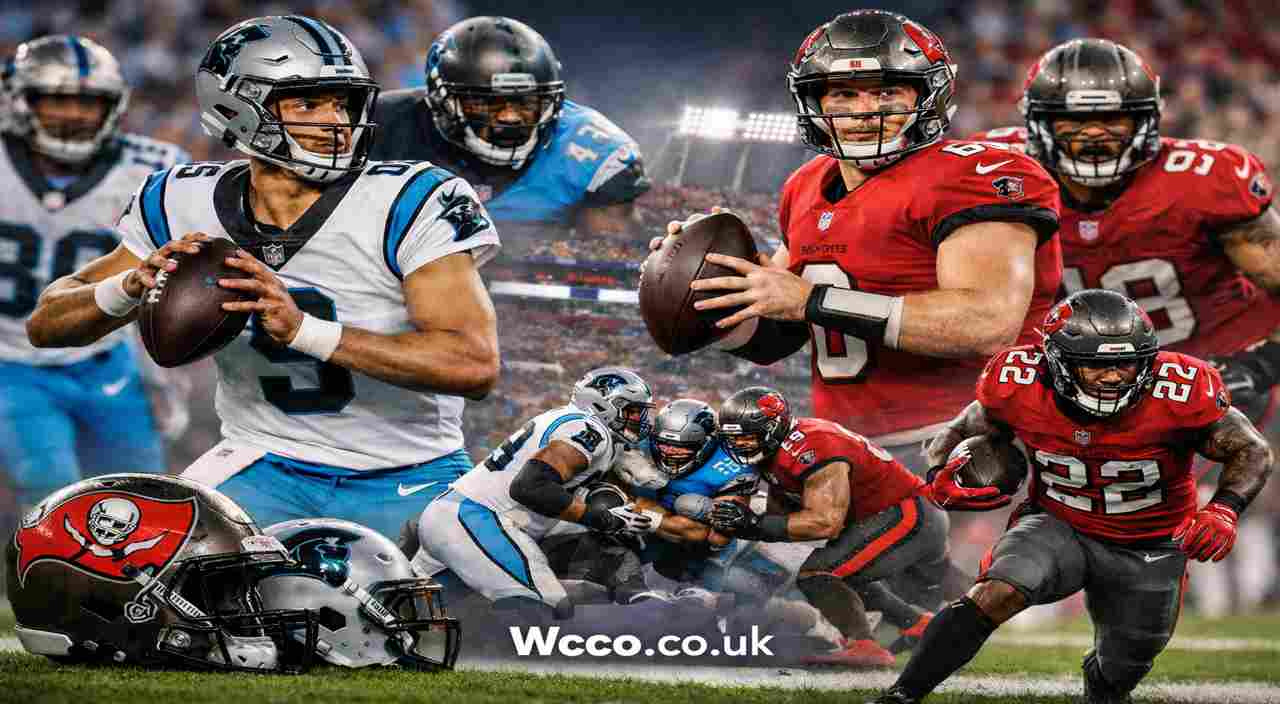
Carolina Panthers vs Tampa Bay Buccaneers Match Player Stats: A Detailed Breakdown of the Week 18 Showdown

Introduction to the Match
The Carolina Panthers vs Tampa Bay Buccaneers match player stats reveal a tight contest that kept fans on the edge of their seats. This Week 18 game, played on January 3, 2026, at Raymond James Stadium, ended with the Buccaneers edging out a 16-14 victory. Both teams finished the season at 8-9, but this win helped Tampa Bay stay in the hunt for the NFC South title. The stats highlight how defense and field goals played a big role, with limited touchdowns and key turnovers deciding the outcome. Players like Bryce Young and Baker Mayfield showed poise under pressure, making this a classic divisional rivalry battle.
Looking deeper into the Carolina Panthers vs Tampa Bay Buccaneers match player stats, we see a game where rushing dominated for one side while passing kept the other in it. The Panthers struggled on the ground, gaining just 19 rushing yards, which forced Young to throw more. In contrast, the Buccaneers racked up 140 rushing yards, controlling the clock and limiting Carolina’s chances. Turnovers hurt the Panthers, with two lost fumbles shifting momentum. This match underscores the importance of ball security and a balanced attack in close games, offering lessons for future matchups.
Game Overview and Key Moments
The game started strong for the Buccaneers, who scored 10 points in the first quarter through a touchdown and a field goal. The Panthers responded in the second with a touchdown to make it 13-7 at halftime. The third quarter was scoreless, building tension as both defenses stepped up. In the fourth, Carolina tied it at 14-14 with another touchdown, but Tampa Bay sealed the win with a late field goal. Total yards favored the Buccaneers at 343 to Carolina’s 285, showing their edge in efficiency.
Key moments in the Carolina Panthers vs Tampa Bay Buccaneers match player stats include turnovers that changed the flow. Carolina’s three fumbles, two of which were lost, gave Tampa Bay short fields and extra possessions. On the flip side, the Buccaneers had one interception but recovered their own fumbles. These errors highlight how small mistakes can decide low-scoring games. The match also featured strong clock management by Tampa Bay, who held the ball for longer periods thanks to their run game, wearing down the Panthers’ defense over time.
Passing Performance Analysis
Panthers’ Passing Stats
Bryce Young led the Panthers’ passing attack, completing 24 of 35 attempts for 266 yards, two touchdowns, and one interception. His average of 7.6 yards per attempt shows he pushed the ball downfield effectively, especially under pressure with no sacks taken. Young’s quarterback rating of 98.0 reflects a solid outing, but the interception in a critical moment hurt their comeback chances. This performance builds on his growth, as he connected with nine different receivers, spreading the ball to keep the defense guessing.
In reviewing the Carolina Panthers vs Tampa Bay Buccaneers match player stats, Young’s two touchdowns came on short passes that exploited mismatches. One went to Jalen Coker for 8 yards, and the other to Tommy Tremble for 6 yards, both in the red zone. His ability to avoid sacks despite a shaky offensive line speaks to his mobility and quick release. However, the interception thrown under duress points to areas for improvement, like better decision-making when blitzed. Overall, Young’s stats suggest he’s becoming a reliable starter, capable of leading drives in tough road games.
Buccaneers’ Passing Stats
Baker Mayfield handled the Buccaneers’ passing duties, going 16 for 22 with 203 yards, one touchdown, and one interception. Despite two sacks for a loss of 5 yards, he maintained a 9.2 yards per attempt average, indicating efficient throws. His 97.3 rating shows consistency, though the interception stalled a promising drive. Mayfield’s performance was key in setting up field goals that proved decisive.
Focusing on the Carolina Panthers vs Tampa Bay Buccaneers match player stats, Mayfield’s touchdown pass went to Cade Otton for a short gain, highlighting his accuracy in tight windows. He targeted nine receivers but leaned heavily on Otton, who accounted for nearly half his yards. The sacks came from Carolina’s edge rushers, but Mayfield bounced back quickly, using his legs for 31 rushing yards too. This dual-threat ability added unpredictability, helping Tampa Bay convert third downs and control the game’s pace.
Will You Check This Article: Tampa Bay Buccaneers vs Carolina Panthers Match Player Stats: A Full Breakdown
Rushing Breakdown
Panthers’ Rushing Stats
The Panthers’ rushing game faltered, totaling just 14 carries for 19 yards at 1.4 yards per attempt. Chuba Hubbard led with 5 carries for 10 yards, averaging 2.0 per run, while Rico Dowdle added 7 for 10 yards. Bryce Young chipped in with 2 carries but lost a yard. This poor output forced the team into pass-heavy situations, exposing them to turnovers. The long run was only 5 yards, showing a lack of explosive plays on the ground.
Examining the Carolina Panthers vs Tampa Bay Buccaneers match player stats, the rushing woes stemmed from Tampa Bay’s stout front seven, which stuffed runs at the line. Hubbard’s efforts were gritty but ineffective against stacked boxes, and Dowdle couldn’t find gaps either. Young’s negative yards came from scrambles gone wrong. This imbalance hurt Carolina’s play-action passes and time of possession, allowing the Buccaneers to dictate terms. Improving the run game could open up more opportunities for Young in future contests.
Buccaneers’ Rushing Stats
Tampa Bay dominated on the ground with 42 carries for 140 yards, averaging 3.3 per attempt. Bucky Irving starred with 26 carries for 85 yards, his longest at 9 yards. Baker Mayfield added 4 for 31, Rachaad White 7 for 23, and others contributed minimally. This volume helped control the clock and set up play-action passes, wearing down Carolina’s defense.
In the Carolina Panthers vs Tampa Bay Buccaneers match player stats, Irving’s consistent gains between the tackles kept drives alive, converting key first downs. Mayfield’s rushes, including an 11-yard scamper, added a quarterback run element that caught the Panthers off guard. White provided change-of-pace bursts, though his average was modest. The team’s negative yards from Tucker highlight occasional miscues, but overall, this rushing attack was the foundation of their victory, limiting Carolina’s offensive snaps.
Receiving Highlights
Panthers’ Receiving Stats
Carolina’s receivers caught 24 passes for 266 yards, averaging 11.1 per reception with two touchdowns. Tetairoa McMillan led with 4 catches for 85 yards, his long of 40 showing big-play potential. Jalen Coker had 6 for 47 and a score, while Tommy Tremble added 3 for 38 and a touchdown. Nine players caught passes, demonstrating Young’s distribution skills.
Breaking down the Carolina Panthers vs Tampa Bay Buccaneers match player stats, McMillan’s yards came on deep routes that stretched the field, forcing Tampa Bay to respect the vertical threat. Coker’s touchdown grab in traffic showed reliable hands in the end zone. Tremble’s score on a seam route exploited linebacker coverage. Shorter gains from Legette and others kept chains moving. Despite fumbles by McMillan and Dowdle, the group provided Young with options, though drops on two targets hurt efficiency.
Buccaneers’ Receiving Stats
The Buccaneers’ pass catchers totaled 16 receptions for 203 yards, averaging 12.7 per catch with one touchdown. Cade Otton dominated with 7 for 94 and the score, his long 22 yards. Mike Evans added 2 for 34, and others like White and Irving chipped in. Nine targets were spread, but Otton’s volume stood out.
In analyzing the Carolina Panthers vs Tampa Bay Buccaneers match player stats, Otton’s performance as a safety valve for Mayfield was crucial, converting third downs with his route running. Evans’ limited catches still drew double coverage, opening space underneath. Running backs like White and Irving on check-downs added yards after catch. The group’s efficiency, with no drops noted, helped sustain drives leading to field goals. This balanced approach complemented the strong run game.
Defensive Contributions
Panthers’ Defensive Stats
Carolina’s defense recorded 81 total tackles, 2 sacks, 5 tackles for loss, and 3 passes defended. Derrick Brown led with 13 tackles, while Tre’von Moehrig had a sack and Nick Scott 9 tackles. They held Tampa Bay to 16 points but couldn’t stop the run, allowing 140 yards. One interception was missing, but fumble recoveries helped.
The Carolina Panthers vs Tampa Bay Buccaneers match player stats show the defense’s effort in pressuring Mayfield with 4 quarterback hits. Brown’s interior presence disrupted plays, and Rozeboom’s 2 passes defended limited big gains. However, missed tackles on runs allowed Irving’s yards. The unit’s resilience kept the game close, forcing field goals instead of touchdowns. Strengthening run defense could make them even tougher in rematches.
Buccaneers’ Defensive Stats
Tampa Bay’s defense tallied around 40 tackles (partial data), with Lavonte David leading at 6. They had no sacks but 3 tackles for loss and 2 passes defended, plus an interception by Jacob Parrish. Holding Carolina to 19 rush yards was key, forcing turnovers that swung momentum.
Reviewing the Carolina Panthers vs Tampa Bay Buccaneers match player stats, the Buccaneers’ front stuffed runs effectively, with Vea and Diaby contributing tackles for loss. Winfield’s pass defended disrupted a drive. The interception sealed a stop, and fumble recoveries prevented scores. This opportunistic play, combined with solid coverage, limited Young’s options late. Their performance was pivotal in a defensive slugfest.
Related: Bengals vs Cleveland Browns Match Player Stats: In-Depth Analysis of the 2025 Season Games
Special Teams and Kicking
Ryan Fitzgerald for the Panthers went 0-for-1 on field goals but perfect 2-for-2 on extra points. Chase McLaughlin for the Buccaneers hit 3-of-4 field goals, including a 48-yarder, and 1-for-1 on extras. These kicks were game-changers, with McLaughlin’s makes providing the margin of victory.
In the Carolina Panthers vs Tampa Bay Buccaneers match player stats, special teams also included punting and returns, though details show minimal impact from returns. Fitzgerald’s miss from beyond 50 yards hurt a potential tie or lead. McLaughlin’s reliability under pressure, missing only one, showed veteran poise. Strong punting pinned opponents deep, aiding field position battles. Special teams often decide close games like this one.
Standout Players and Insights
Standouts in the Carolina Panthers vs Tampa Bay Buccaneers match player stats include Bucky Irving’s 85 rushing yards, controlling the game for Tampa Bay. Cade Otton’s 94 receiving yards and touchdown made him a go-to target. For Carolina, Tetairoa McMillan’s 85 yards provided sparks, and Bryce Young’s 266 passing yards kept them competitive despite run struggles.
These performances offer insights: Irving’s workload suggests Tampa Bay’s trust in his vision. Otton’s chemistry with Mayfield highlights tight end importance in their scheme. McMillan’s deep threats could evolve Carolina’s offense. Turnovers from both sides emphasize clean play. Comparing to their December 21 game, where Carolina won 23-20, shows flipped rushing dominance, proving adaptability wins divisions.
Conclusion: Lessons from the Stats
The Carolina Panthers vs Tampa Bay Buccaneers match player stats paint a picture of a hard-fought battle where execution mattered most. Tampa Bay’s balanced approach and fewer mistakes secured the win, while Carolina’s passing heroics nearly overcame their ground issues. Fans can learn from how stats like yards per carry and turnover differential directly impact outcomes. As both teams look ahead, refining these areas will be key to playoff pushes. This game reminds us why NFC South rivalries deliver thrilling football every time.

How Distracted Driving Is Putting Los Angeles Cyclists at Risk

What to Do After an Elevator Accident in California

Progressive Web Apps vs Native Mobile Apps: Which Should Dubai Businesses Choose?

A Complete Guide to UploadArticle.com: Your Platform for Sharing Articles Online

seo companies 2025 aelftech com – A Close Look at Services & Results

Understanding Archivebate: A Full Guide to the Webcam Archive Platform
-
 Business1 week ago
A Complete Guide to UploadArticle.com: Your Platform for Sharing Articles Online
-
 Tech1 week ago
seo companies 2025 aelftech com – A Close Look at Services & Results
-
 Lifestyle2 weeks ago
Understanding Archivebate: A Full Guide to the Webcam Archive Platform
-

 Tech1 week ago
Understanding Crackstube: A Complete Guide to the Term, Sites, and Safe Choices
-

 Business1 week ago
Brisbane Local SEO Companies Aelftech Com: A Complete Guide to Top Services in 2026
-

 Business1 week ago
The Ultimate Guide to UploadBlog Guest Post: Everything You Need to Know
-

 Finance3 weeks ago
5StarsStocks: A Full Guide to Better Stock Choices
-

 Tech1 week ago
Top Magento Service Companies by Aelftech.com